
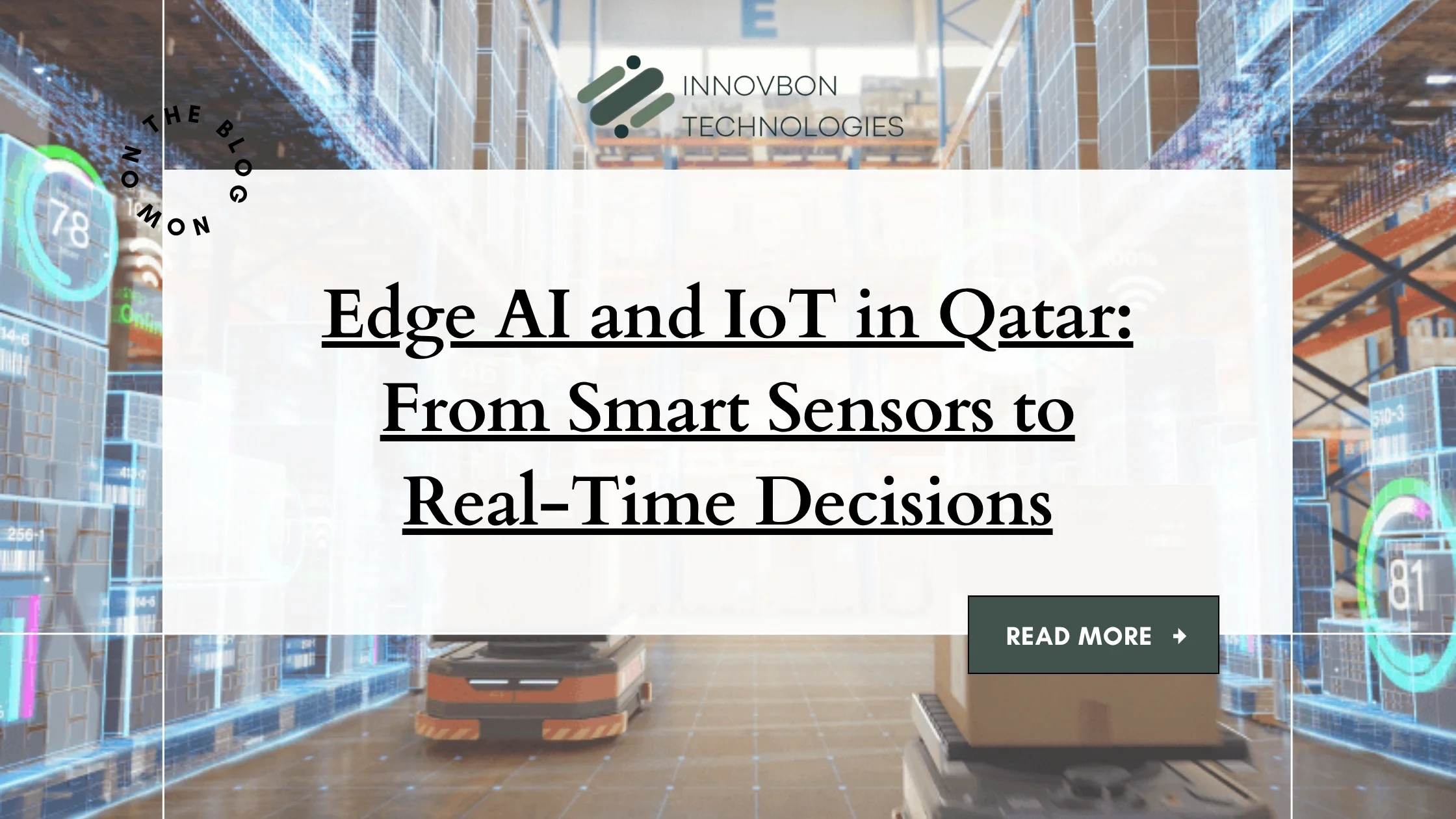
In 2024–2025, one of the most important shifts in AI is happening away from the cloud and towards the edge. Instead of sending every camera feed, sensor reading, or transaction to a distant data center, companies are increasingly running AI models directly on devices—cameras, gateways, robots, industrial controllers, and even point-of-sale terminals.
This is edge AI: combining AI models with Internet of Things (IoT) devices so that data is processed where it is generated. For Qatar and GCC businesses, this isn’t a futuristic concept; it is becoming a practical way to reduce latency, cut connectivity costs, protect sensitive data, and keep operations running even when the network is unreliable.
Global leaders like NVIDIA, Qualcomm, and Arm are releasing powerful edge AI chips; cloud providers like Microsoft Azure and AWS now ship full edge stacks; and industrial vendors like Siemens and Schneider Electric are embedding AI into PLCs and gateways. At the same time, regional initiatives—from Qatar’s smart city ambitions to Saudi Arabia’s giga-projects—are creating strong demand for real-time, on-site intelligence.
This blog explains what edge AI really means today, why it matters for Qatar and GCC SMEs (not just mega-projects), and how a structured approach—supported by a specialist partner like Innovbon—can turn pilots into production systems.

What’s New in Edge AI and IoT in 2024–2025?
Edge AI is not new, but three recent developments are making it far more practical and affordable for SMEs in the GCC:
1. Powerful, Low-Cost Edge Hardware
Hardware that once cost thousands of dollars is now available at SME-friendly price points:
- NVIDIA Jetson Orin Nano / Orin NX: compact modules capable of running advanced computer vision and deep learning models at the edge. They are increasingly used in smart factories, logistics hubs, and retail analytics.
- Qualcomm AI-enabled chipsets (e.g., Snapdragon series): powering AI on cameras, kiosks, and handheld devices, enabling real-time object detection, face blurring, and anomaly detection without cloud round-trips.
- Arm Cortex-M and Cortex-A microcontrollers: embedded in industrial sensors and gateways, now capable of running tinyML models for vibration analytics, energy optimization, and predictive maintenance.
These platforms are becoming widely available through regional distributors in the GCC, making it realistic for a mid-sized manufacturer or logistics operator in Qatar to deploy edge AI without a massive capex project.
2. Mature Software Stacks and MLOps for the Edge
A major barrier used to be software complexity: how to deploy, update, and monitor AI models on dozens or hundreds of devices. In 2024–2025, that is changing:
- Azure IoT Edge and AWS IoT Greengrass provide containers, device management, and secure communication for edge workloads, with strong integration to cloud AI services.
- Open-source frameworks like EdgeX Foundry, KubeEdge, and OpenVINO help standardize how data from multiple vendors’ devices is collected and how AI models are deployed.
- Edge MLOps tools (e.g., OctoML, Roboflow, Weights & Biases with edge integrations) allow continuous improvement of models based on real-world data while keeping sensitive data on-premise.
This means SMEs no longer need a large in-house platform team to manage edge AI; with the right architecture and support from a partner like Innovbon’s AI forward engineers, they can adopt proven stacks and focus on business value.
3. Regional Push for Smart Infrastructure
Edge AI aligns closely with ongoing investments in the GCC:
- Smart cities and districts in Qatar (e.g., Lusail, Msheireb Downtown) rely on distributed sensors and cameras for traffic, security, and energy management—ideal environments for edge analytics.
- Industrial zones and free zones across the GCC are modernizing logistics and manufacturing operations, where running AI directly on equipment can reduce downtime and improve safety.
- National AI strategies in Qatar and neighboring countries emphasize data sovereignty and privacy, which edge AI supports by minimizing raw data sent to the cloud.
As these initiatives mature, suppliers and SMEs in their ecosystems will be expected to meet higher standards of automation, traceability, and responsiveness—precisely what edge AI and IoT can deliver.
Why Edge AI Matters for Qatar and GCC SMEs
Many SMEs in the region already have CCTV systems, PLCs, SCADA, and basic IoT sensors. The challenge is that these systems generate data that is rarely analyzed in real time. Edge AI turns this passive data into immediate decisions.
1.Lower Latency and Higher Reliability
For use cases like workplace safety, asset tracking, or equipment protection, waiting even a few seconds for a cloud round-trip can be too slow. Edge AI enables:
- Instant alerts when a worker enters a restricted zone.
- Real-time cut-off if a machine exceeds safe vibration thresholds.
- On-the-spot verification of goods at loading docks.
This is especially valuable in industrial zones or remote sites where connectivity can be inconsistent or expensive.
2.Cost Savings on Connectivity and Cloud
Streaming high-resolution video or dense sensor data to the cloud 24/7 is costly. Edge AI allows SMEs to:
- Process raw data locally and send only events and summaries.
- Use local storage with smart retention policies instead of continuous cloud archiving.
- Reduce dependency on high-bandwidth links, especially in distributed operations.
For a logistics SME with multiple warehouses in Qatar and the wider GCC, this can translate into tangible OPEX reductions.
3.Data Privacy and Regulatory Alignment
With rising expectations around data protection and sectoral regulations, many organizations are cautious about sending sensitive video or operational data to the cloud. Edge AI supports:
- On-device anonymization (e.g., face blurring, license plate masking) before any data leaves a site.
- Local retention of detailed data, with only aggregated metrics shared across systems.
- Better alignment with data sovereignty and compliance requirements in the GCC.
Practical Edge AI Use Cases for Qatar and GCC Businesses
Below are concrete scenarios where SMEs and enterprises in the region can adopt edge AI today, often leveraging existing infrastructure.
1. Smart Warehousing and Logistics Hubs
GCC economies depend heavily on trade and logistics. In a typical warehouse in Qatar, you might find CCTV cameras, barcode scanners, and a warehouse management system (WMS). Edge AI can add intelligence without replacing everything:
- Automated pallet and carton counting: Edge cameras with computer vision models can count items as they move through loading bays, flag discrepancies, and feed data into the WMS in real time.
- Forklift and pedestrian safety: AI models running on edge devices can detect near-misses, enforce speed zones, and trigger alerts when humans enter restricted paths.
- Condition monitoring for cold chain: Temperature and humidity sensors with on-board anomaly detection models can trigger alerts before thresholds are breached, protecting sensitive goods.
These are not theoretical: global logistics providers and major ports are already deploying similar solutions, and the underlying technologies are accessible to regional SMEs with the right integration support.
2. Predictive Maintenance in Manufacturing and Utilities
Manufacturing plants, desalination facilities, and power utilities across the GCC operate critical rotating equipment—pumps, compressors, motors. Edge AI enables:
- Vibration analytics: Small, battery-powered sensors running tinyML models can identify early signs of bearing wear or misalignment, triggering maintenance before failure.
- Energy optimization: Edge controllers can learn normal consumption patterns and detect anomalies that indicate leaks, inefficiencies, or misuse.
- Visual inspection: Cameras with on-device defect detection models can inspect product surfaces, welds, or assembly steps without sending video to the cloud.
For SMEs supplying to large industrial customers in Qatar, such capabilities can become a differentiator when competing for contracts that require reliability and digital maturity.
3. Smart Retail and Customer Experience
In malls and retail chains across Doha and the wider GCC, edge AI can enhance both operations and customer experience:
- Queue and occupancy analytics: Edge cameras measure queue lengths and footfall in real time, prompting staff reallocation or opening new counters.
- Planogram compliance and shelf monitoring: Computer vision models detect empty shelves or misplaced products, helping staff restock quickly.
- In-store behavior insights: Anonymized tracking of customer movement patterns—processed at the edge—helps optimize store layouts and promotions.
Crucially, sensitive video does not need to leave the premises; only aggregated metrics and events are sent to central systems, aligning with privacy expectations.
4. Safety and Compliance on Construction Sites
With ongoing infrastructure development in Qatar and the GCC, construction safety remains a priority. Edge AI can support:
- PPE detection: Cameras verify whether workers are wearing helmets, vests, and harnesses.
- Zone intrusion alerts: Real-time detection when unauthorized personnel enter hazardous areas.
- Equipment misuse detection: Monitoring for unsafe operation of cranes, lifts, or heavy vehicles.
Because these models run on local devices, they work even on sites with limited connectivity, and data can be stored on-site to satisfy client or regulator requirements.
Designing an Edge AI Architecture That Works in the GCC
Successful edge AI projects balance local intelligence with central coordination. A typical architecture for a Qatar or GCC SME might include:
1.Device Layer: Sensors and Cameras
This includes existing CCTV, industrial sensors, PLCs, and new IoT devices. The goal is to reuse as much as possible while adding AI-ready endpoints where needed.
2.Edge Compute Layer: Gateways and Micro-Data Centers
Edge gateways (industrial PCs, Jetson devices, or ruggedized servers) run:
- AI inference models (e.g., object detection, anomaly detection).
- Data aggregation and filtering logic.
- Local dashboards or APIs for on-site teams.
3.Connectivity Layer: Secure, Optimized Links
Not all data needs to go to the cloud. Instead, SMEs can send:
- Summarized metrics and events.
- Occasional samples of raw data for model retraining.
- Configuration updates and model versions from central systems.
4.Cloud or Data Center Layer: Coordination and Analytics
Central systems—either in the public cloud or a local data center—handle:
- Model training and evaluation.
- Fleet management for edge devices.
- Enterprise reporting, dashboards, and integration with ERP/WMS/CRM.
Designing this architecture requires careful trade-offs between performance, cost, and regulatory constraints. This is where Innovbon’s experience in GCC environments becomes valuable: understanding local connectivity realities, data regulations, and integration with existing OT/IT systems.
From Pilot to Production: A Realistic Edge AI Roadmap for SMEs
Many organizations in the GCC have experimented with isolated AI or IoT pilots that never scaled. To avoid this, SMEs should approach edge AI as a business program, not a gadget experiment.
Step 1: Identify High-Impact, Narrow Use Cases
Start with problems that are:
- Operationally painful (e.g., recurring safety incidents, stock discrepancies).
- Measurable in terms of cost or risk.
- Constrained to a specific area or process (one warehouse, one line, one store).
Innovbon typically works with SMEs to run a short discovery workshop, mapping current data sources and operational bottlenecks to candidate edge AI use cases.
Step 2: Build a Small, Production-Ready Pilot
Instead of a lab demo, design a pilot that operates in real conditions:
- Use realistic hardware and connectivity.
- Integrate with at least one core system (e.g., WMS, maintenance system).
- Define clear KPIs: reduced incidents, faster throughput, fewer manual checks.
Innovbon’s AI forward engineers focus on making these pilots maintainable: containerized models, remote updates, monitoring, and clear handover to operations teams.
Step 3: Establish Edge AI Governance and Operations
As edge AI scales across sites, governance becomes essential:
- Standardize device types and configurations.
- Define who approves model updates and how they are tested.
- Set up logging, alerting, and incident response for edge systems.
This is where many pilots fail; they work technically but lack an operational model. Innovbon helps clients design lightweight processes that fit SME realities while aligning with enterprise-grade practices.
Step 4: Scale Across Sites and Use Cases
Once the first pilot shows value, scaling becomes a matter of replicating patterns:
- Rolling out the same solution to additional warehouses, plants, or stores.
- Adding new models to the same edge platform (e.g., from safety monitoring to productivity analytics).
- Integrating insights into broader business intelligence and planning systems.
Key Considerations: Security, Interoperability, and Skills
1.Security at the Edge
Edge devices can be an attack surface if not properly managed. Best practices include:
- Secure boot and encryption on devices.
- Network segmentation between OT and IT.
- Centralized identity and access management for edge nodes.
2.Interoperability with Existing Systems
In GCC industrial and logistics environments, there is often a mix of legacy and modern equipment. Edge AI platforms must support:
- Standard protocols (Modbus, OPC UA, MQTT, REST APIs).
- Vendor-neutral data models where possible.
- Gradual migration strategies that respect existing investments.
3.Skills and Operating Model
Most SMEs will not hire large AI or IoT teams. Instead, a hybrid model works best:
- A small internal team that understands operations and basic digital concepts.
- An external partner, such as Innovbon, providing AI architects and edge engineers on a flexible basis.
- Clear documentation and training so that local staff can operate day-to-day systems.
How Innovbon Helps Qatar and GCC Organizations Adopt Edge AI
Innovbon is an AI consultancy focused on helping SMEs and enterprises in Qatar and the GCC move from AI concepts to working systems embedded in daily operations. For edge AI and IoT, our approach typically includes:
- Opportunity assessment: Mapping existing sensors, cameras, and systems to prioritized edge AI use cases.
- Architecture and vendor selection: Choosing appropriate hardware, software stacks, and cloud/edge platforms suited to local conditions.
- Model development and integration: Training or adapting AI models and integrating them with existing OT/IT systems.
- Deployment and MLOps: Implementing robust deployment, monitoring, and update mechanisms for edge fleets.
- Capability building: Training internal teams and establishing lightweight governance so solutions remain sustainable.
Whether you are a logistics SME looking to automate warehouse checks, a manufacturer aiming for predictive maintenance, or a retailer seeking real-time store insights, Innovbon can provide the expertise and engineering capacity to design, implement, and scale edge AI in your operations.
Next Steps for Qatar and GCC Leaders
Edge AI and IoT are moving from buzzwords to practical tools that can deliver measurable gains in safety, efficiency, and customer experience. The technology is now mature enough—and affordable enough—for SMEs, not just mega-projects.
The organizations that will benefit most are those that:
- Start with focused, operationally relevant use cases.
- Treat edge AI as part of their core processes, not a one-off experiment.
- Partner with specialists who understand both AI technology and GCC operational realities.
If you are ready to explore how edge AI and IoT can support your day-to-day operations in Qatar or across the GCC, consider a structured assessment and pilot with a dedicated AI partner. Innovbon’s AI forward engineers can help you design a roadmap that fits your scale, budget, and regulatory environment.
Sources:
- https://developer.nvidia.com/embedded/jetson-modules
- https://azure.microsoft.com/en-us/products/iot-edge
- https://aws.amazon.com/greengrass/
- https://www.edgexfoundry.org/
- https://kubeedge.io/en/
- https://www.qna.org.qa/en-us/News-And-Reports/Reports/Pages/Qatar-National-Artificial-Intelligence-Strategy.aspx


0 Comments