
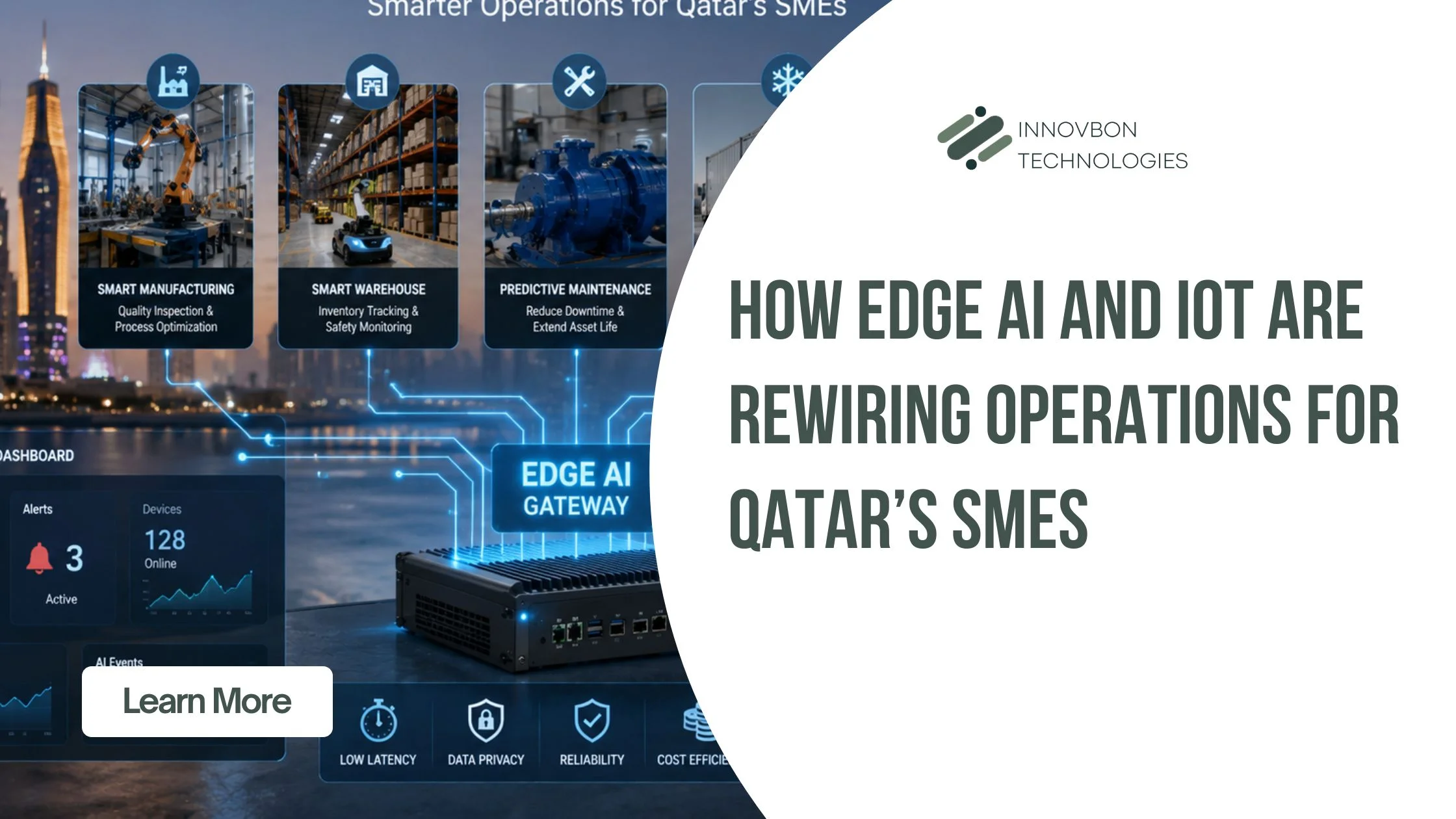
In the last 18 months, Edge AI has quietly moved from experimental pilots into production at scale. Chipmakers like NVIDIA (Jetson Orin Nano), Qualcomm (RB3 Gen 2), and Google (Edge TPU) have released low‑power, high‑performance edge modules that can run vision and predictive models directly on cameras, gateways, and industrial controllers—without relying on constant cloud connectivity.
At the same time, global industrial players are reporting measurable outcomes. Siemens and NVIDIA’s 2024 collaboration on industrial Edge AI has shown up to 30% reduction in unplanned downtime in early manufacturing deployments. In logistics, DHL has reported double‑digit productivity gains from computer‑vision‑enabled parcel sorting and real‑time tracking in its smart warehouses.
These are not just big‑enterprise stories. The cost of an edge AI starter kit (camera + gateway + pre‑trained model) has dropped into the USD 800–2,000 range—suddenly realistic for small factories, car workshops, clinics, and retail chains across Qatar and the GCC.
For SMEs in Doha, Riyadh, Dubai, and Muscat, this is a turning point: instead of sending all data to the cloud, you can now run AI directly where the data is generated—on shop floors, in vehicles, at construction sites, and inside cold rooms.
What Exactly Is Edge AI (and Why Not Just Use the Cloud)?
Edge AI means running AI models on local devices—cameras, gateways, routers, robots, or even smart sensors—instead of in a remote data centre. These devices are usually connected via the Internet of Things (IoT), but the core processing happens on the edge hardware itself.

Cloud vs Edge: The Trade‑Offs
- Latency: Edge AI can react in milliseconds, while cloud AI depends on network quality. For quality control on a fast‑moving production line, milliseconds matter.
- Bandwidth & cost: Streaming HD video from 20 cameras to the cloud 24/7 is expensive. Processing video locally and sending only alerts and summaries dramatically cuts data costs.
- Reliability: In warehouses, construction sites, or moving vehicles, connectivity is often unstable. Edge AI keeps working even when the network drops.
- Data sovereignty & privacy: Sensitive images, faces, or operational data can stay on‑premise, which aligns better with regional data protection expectations and sectoral regulations.
Qatar’s digital agenda and the wider GCC’s Industry 4.0 programmes are increasingly emphasising cyber‑resilience and data localisation. Edge AI fits naturally into this direction: local processing, selective sharing, and tight control over where data lives.
Recent Edge AI Developments SMEs Should Know About (2024–2025)
Several 2024–2025 developments have lowered the barrier for SMEs to adopt Edge AI and IoT without building huge data science teams.
1. Pre‑built Vision Models for Common SME Scenarios
Major platforms now offer ready‑made computer vision models that run on edge devices:
- Azure Percept / Azure IoT Edge vision modules provide pre‑trained models for people counting, PPE detection, vehicle recognition, and occupancy analytics.
- Google Vertex AI Vision supports on‑device deployment via Edge TPU, allowing object detection and quality inspection at the edge.
- NVIDIA Metropolis for Factories bundles industrial inspection and safety models optimised for Jetson edge devices.
For a Qatari SME, this means that instead of designing a vision model from scratch, you can adapt an existing one for tasks like detecting defects in tiles, monitoring safety helmet usage, or counting customers in retail.
2. TinyML and Ultra‑Low‑Power Sensors
TinyML—running ML models on microcontrollers—has matured. Platforms like Edge Impulse and TensorFlow Lite Micro now support vibration analysis, anomaly detection, and predictive maintenance models on battery‑powered devices costing under USD 50.
For GCC SMEs operating pumps, compressors, motors, or HVAC units, this enables cheap, distributed monitoring across multiple sites without complex infrastructure.
3. 5G and Private LTE in Industrial Zones
Gulf operators have been rolling out 5G and private LTE in industrial and logistics zones. This enables high‑bandwidth, low‑latency connectivity for fleets of edge devices—CCTV cameras, AGVs, drones, and sensors—while still processing most AI workloads locally.
In Qatar, the combination of 5G and edge gateways in free zones or industrial areas can unlock real‑time tracking, asset monitoring, and safety analytics for SMEs sharing the same digital infrastructure.
Qatar & GCC Use Cases: Edge AI in Day‑to‑Day SME Operations
Below are practical, 2025‑ready scenarios that SMEs in Qatar and the GCC can deploy within months—not years.
1. Smart Cold Chain for Food & Pharma SMEs
Food distributors, cloud kitchens, and pharma wholesalers across the GCC share a common risk: temperature excursions that spoil inventory and breach compliance requirements.
Edge AI + IoT can provide:
- Continuous sensor monitoring of temperature, humidity, and door activity in cold rooms, trucks, and display fridges.
- On‑device anomaly detection that flags unusual patterns—like a compressor slowly failing—before a full breakdown.
- Automated compliance reports summarising conditions for each batch, ready for regulators or customers.
A practical deployment might combine low‑cost LoRaWAN sensors, an edge gateway running predictive models, and a simple dashboard. Cloud is used only for dashboards and alerts, while the heavy analytics run at the edge.
2. Vision‑Based Safety in Workshops and Construction Sites
Construction, maintenance, and fabrication SMEs face safety and insurance pressure. Edge‑enabled cameras can run AI models to:
- Detect missing helmets, vests, or gloves (PPE detection).
- Recognise people entering restricted zones or walking under suspended loads.
- Trigger local alarms or send alerts to supervisors in real time.
Because the analysis runs on the camera or gateway, you don’t need to stream or store all video in the cloud. Only events and short clips are uploaded, reducing bandwidth and addressing privacy concerns.
3. Predictive Maintenance for Light Manufacturing and Facilities
Unplanned downtime is a hidden tax on SMEs operating machinery—CNC machines, packaging lines, pumps, or elevators. With vibration, current, and acoustic sensors connected to edge devices, AI models can learn each machine’s normal behaviour and flag anomalies.
In 2024, multiple industrial vendors reported 20–40% reductions in unplanned downtime using edge‑based predictive maintenance. For a mid‑sized factory in Qatar, that can translate into hundreds of thousands of riyals in saved production time annually.
4. Smart Retail Shelves and Queue Analytics
Retail SMEs and convenience store chains can use edge cameras to:
- Monitor shelf stock levels and detect empty facings.
- Measure queue lengths and waiting times at checkouts.
- Analyse customer movement patterns in stores to optimise layouts.
Instead of sending video feeds to the cloud, the store gateway can compute metrics locally and push only anonymised counts and heatmaps to a central dashboard—ideal for multi‑branch retailers across Doha or the wider GCC.
5. Fleet and Field Operations Intelligence
Service SMEs—HVAC maintenance, facility management, logistics, and delivery—can embed Edge AI in vehicles and handheld devices to:
- Optimise routes based on real‑time traffic and job priority.
- Detect harsh driving, idling, or fuel‑wasting behaviour using accelerometer and engine data.
- Capture on‑site photos and run AI checks (e.g., verifying meter readings or installation quality) directly on the device.
Combining GPS trackers, CAN‑bus readers, and on‑device models can deliver savings in fuel, overtime, and asset wear—without requiring constant connectivity to a central server.
How Edge AI Aligns with Qatar and GCC Strategic Directions
Qatar National Vision 2030, the region’s broader diversification agenda, and national AI strategies across the GCC all emphasise:
- Industrial competitiveness through automation and advanced analytics.
- Resilient, secure infrastructure for critical sectors like energy, logistics, and healthcare.
- SME empowerment as engines of employment and innovation.
Edge AI directly supports these goals by:
- Enabling Industry 4.0 capabilities (predictive maintenance, quality inspection, safety analytics) even for smaller factories and utilities.
- Reducing dependency on external cloud regions and improving data sovereignty.
- Creating demand for new technical roles—from AI forward engineers to edge solution architects—within local SMEs.
Common Barriers for SMEs—and How to Overcome Them
Despite the clear benefits, many SMEs in Qatar and the GCC hesitate to adopt Edge AI and IoT. The reasons are understandable—and solvable.
1. “We Don’t Have Data Scientists or AI Engineers”
Modern Edge AI platforms increasingly provide no‑code or low‑code interfaces for model deployment and monitoring. The real gap is not only data science—it’s the ability to translate day‑to‑day operations into AI‑ready problems and workflows.
This is where AI Forward Engineers become critical: professionals who understand both your business operations and the AI toolchain, and can embed models into existing processes without disrupting the business.
2. Fear of High Upfront Investment
Many SMEs imagine multi‑million‑riyal projects. In reality, a focused pilot—say, predictive maintenance on your 10 most critical machines, or safety monitoring for a single high‑risk site—can start in the tens of thousands of riyals, not millions.
The key is to prioritise high‑ROI, narrow use cases and use off‑the‑shelf hardware where possible.
3. Integration with Legacy Systems
Many factories and facilities in the GCC run on legacy PLCs, SCADA systems, or basic building management systems. Edge AI does not require ripping these out. Gateways can sit between existing sensors and your network, reading MODBUS, OPC‑UA, or simple analog signals, then applying AI models.
The practical challenge is mapping these signals to meaningful KPIs and designing the right alerts and workflows—exactly the kind of work that a specialised consultancy like Innovbon performs during discovery and design phases.
4. Cybersecurity and Operational Risk
Connecting more devices can increase the cyber attack surface. A robust Edge AI strategy includes:
- Network segmentation and zero‑trust principles for OT/IT.
- Secure device provisioning and firmware update processes.
- Continuous monitoring of device behaviour for anomalies.
The benefit of edge is that sensitive data can stay inside your environment, with only encrypted summaries leaving the site.
Innovbon’s Approach: From Pilot to Scaled Edge AI Operations
Innovbon is an AI consultancy focused on helping SMEs in Qatar and the GCC embed AI into day‑to‑day operations—and providing AI Forward Engineers to large enterprises that need hands‑on implementation capacity.
1. Operational Discovery, Not Just “AI Ideation”
Instead of starting from technology, we start from your operations:
- Where do you lose time, materials, or energy?
- Where are safety incidents or near‑misses happening?
- Which assets cause the most unplanned downtime?
We then map these pain points to concrete Edge AI use cases and estimate ROI in financial terms—before you invest in hardware.
2. Architecture and Vendor‑Neutral Design
Innovbon works with a range of hardware and cloud providers, selecting the right combination for your budget and constraints. This can include:
- Jetson‑class devices for heavy vision workloads.
- Microcontroller‑based TinyML sensors for vibration and temperature.
- Industrial gateways that can talk to your existing PLCs and BMS.
The goal is a modular architecture that you control, not a single‑vendor lock‑in.
3. AI Forward Engineers Embedded with Your Team
Our AI Forward Engineers bridge the gap between your operations staff and AI systems. They:
- Configure and deploy edge devices on‑site.
- Adapt pre‑trained models to your specific environment.
- Design alerting and workflow integrations (e.g., WhatsApp, email, CMMS, ERP).
- Train your team to interpret dashboards and refine rules.
This hands‑on model is particularly suited to SMEs that cannot hire full in‑house AI teams but want to build internal capability over time.
4. Governance, Monitoring, and Continuous Improvement
Edge AI systems are not “set and forget.” Models drift, processes change, and new risks appear. Innovbon helps you establish:
- Monitoring for model performance and false positives/negatives.
- Scheduled retraining or recalibration based on new data.
- Security and access controls aligned with your IT/OT policies.
Over time, your Edge AI stack can expand from one use case (e.g., safety) to multiple (quality, energy, maintenance) on the same hardware base.
How to Get Started: A 90‑Day Edge AI Pilot Roadmap
For Qatar and GCC SMEs, the most effective way to move is with a structured, time‑boxed pilot. A typical 90‑day roadmap with Innovbon looks like this:
Phase 1 (Weeks 1–3): Opportunity and ROI Assessment
- On‑site walkthroughs and data collection.
- Selection of 1–2 high‑impact use cases.
- ROI model and success metrics agreed upfront.
Phase 2 (Weeks 4–8): Pilot Design and Deployment
- Hardware and connectivity design.
- Model selection or adaptation (vision, anomaly detection, etc.).
- Edge device installation and integration with your existing systems.
Phase 3 (Weeks 9–12): Optimisation and Scale‑Up Plan
- Fine‑tuning thresholds and workflows based on real data.
- Documented business impact (downtime reduction, waste reduction, safety improvements).
- Scalability roadmap to additional lines, sites, or branches.
By the end of 90 days, you should have hard numbers to justify further investment—or to pivot to a better use case.
Next Steps for Qatar and GCC SMEs
Edge AI and IoT are no longer experimental technologies reserved for global giants. With the hardware, connectivity, and platforms available in 2025, SMEs in Qatar and the wider GCC can unlock tangible, near‑term benefits in reliability, safety, and efficiency.
The key is to start small, focused, and ROI‑driven—and to work with partners who understand both AI and local operational realities.
If you are exploring how to bring Edge AI into your factory, warehouse, fleet, or retail network, visit Innovbon’s website to discuss a tailored pilot for your operations.
Sources:
- https://blogs.nvidia.com/blog/siemens-nvidia-industrial-metaverse/
- https://developer.nvidia.com/embedded-computing
- https://azure.microsoft.com/en-us/products/iot-edge
- https://cloud.google.com/vertex-ai/docs/vision/overview
- https://edgeimpulse.com/blog
- https://www.qualcomm.com/products/application/industrial-iot
- https://www.gsma.com/futurenetworks/wiki/private-networks/


0 Comments